
60+ Ecommerce Personalization Statistics (2026 Data)

Online shoppers notice everything. The products a store shows them, the emails it sends, the deals it offers. When these match what they want, they buy. When they don’t, they leave.
That is what ecommerce personalization does. It shows each shopper the right thing at the right time. Stores that get this right sell more, and AI has made it easier than ever.
I collected the latest numbers from the biggest studies and checked each one. Here is what the data shows.
Build trust & FOMO
Highlight real-time activities like reviews, sales & sign-ups.


Key Ecommerce Personalization Statistics
Ten numbers that sum up where personalization stands right now.
| Metric | Latest Figure |
|---|---|
| Shoppers who expect personalization | 71% |
| Get frustrated without it | 76% |
| Typical revenue lift | 10% to 15% |
| Cut in customer acquisition cost | Up to 50% |
| Extra spend with brands that personalize with AI | 54% more on average |
| Site revenue from product recommendations | Up to 31% |
| Companies using AI-driven personalization | 92% |
| Holiday 2025 retail sales driven by AI and agents | 20%, worth $262 billion |
| Growth in AI traffic to retail sites | 693% in one year |
| Brands that fully have the data they need | 16% |
Why Ecommerce Personalization Matters
Shoppers have already decided this one. Personalization is not a nice extra anymore. It is the baseline they expect from every store they buy from.
1. 71% of shoppers expect personalized interactions from the brands they buy from.
2. 76% get frustrated when they don’t get them.

3. 72% expect brands to recognize them as individuals and know what they care about.
4. 76% say personalized communication was a key reason they considered a brand in the first place.
5. 78% say personalized content made them more likely to buy again.
6. 64% would quit a brand that doesn’t personalize, and 31% have already switched to one that does.
7. Shoppers spend 54% more on average with brands that personalize using AI.
8. 88% are more likely to buy when personalization happens in real time. Only 44% of brands can pull that off.
That last gap is the whole story. Almost every shopper wants it, and less than half of stores deliver it.
Build trust & FOMO
Highlight real-time activities like reviews, sales & sign-ups.
What Personalization Does to Sales
The money side is well studied at this point, and the numbers hold up across industries.
9. Personalization lifts revenue by 10% to 15% for most companies. The full range runs from 5% to 25% depending on how well it’s done.
10. It also makes marketing budgets go 10% to 30% further.
11. Fast-growing companies get 40% more of their revenue from personalization than slow-growing ones.
12. Targeted offers alone add 1% to 2% in sales and 1% to 3% in margin.
13. Personalization can cut the cost of winning a new customer by up to 50%.
14. Brands with advanced personalization grow twice as fast as brands with basic personalization.
15. Among brands that use AI to tailor experiences, 75% see customers spending more.
16. 62% of business leaders say personalization improved customer retention.
It works on every metric that matters: revenue, order value, acquisition cost, and retention. For the wider market picture, see these ecommerce statistics and trends.
Personalized Product Recommendations
Recommendations are the workhorse of ecommerce personalization. This is where most of the money shows up first.
17. Personalized product recommendations drive up to 31% of ecommerce site revenue.
18. Amazon attributes about 35% of its revenue to its recommendation engine.
19. When shoppers engage with recommendations, revenue from those sessions rises by up to 26%.
20. Shoppers who click a recommendation convert at 4.5 times the rate of those who don’t.
21. Personalized recommendations get twice the click-through rate of generic ones.
22. Placement matters a lot. Recommendations on cart pages drive up to 31% of revenue, while homepage recommendations drive about 7%.
23. 56% of shoppers come back to a site that recommends products they actually like.

Recommendations also open the door to smart upselling and cross-selling. If you want ideas, here are real product recommendation examples that convert.
Build trust & FOMO
Highlight real-time activities like reviews, sales & sign-ups.

What Shoppers and Marketers Say
Both sides of the counter agree that personalization works. They disagree on how well it’s being done.
24. 9 out of 10 marketers say personalization improved their ROI.

25. 89% of business leaders call personalization critical to their success over the next three years.
26. 85% of companies believe they offer personalized experiences. Only 60% of customers agree.
27. 61% of customers say they are often treated like a number instead of a person.
28. 66% would stop buying from a brand if the experience isn’t personalized.
29. 55% are willing to pay more for a customized experience.

30. 48% have made a repeat purchase because of the level of personalization they received.
31. Shoppers who find personalization very appealing are 10 times more likely to become a brand’s most valuable customers.
Build trust & FOMO
Highlight real-time activities like reviews, sales & sign-ups.

The Customer Data Behind Personalization
Personalization is only as good as the data feeding it. And this is where most stores fall short.
32. Only 16% of brands strongly agree they have the customer data they need to personalize.
33. Just 19% say they have a complete profile of their customers.
34. Half of all companies struggle to get accurate data for personalization, up 10 points in two years.
35. 31% say poor data quality is the main thing holding back their AI personalization.
36. Brands built on first-party data see 2.9 times higher revenue lift and 1.5 times better cost savings.
37. 44% of shoppers say they will likely buy again after a personalized shopping experience.

38. 66% of shoppers want companies to understand their individual needs.

The takeaway: collect your own data from your own customers, keep it clean, and build on that.
Trust and Privacy
Shoppers will trade data for relevance. But the trade has conditions attached.
39. 83% will share their data to get a more personalized experience.
40. 57% share personal info in exchange for personalized offers or discounts.

41. 73% want transparency about how their data gets used.

42. 49% trust a brand more when it explains how customer data is used in its AI.
43. Only 15% fully trust brands with their data.
44. 84% want control over their own personalization settings.
45. 61% don’t believe brands use their data in the customer’s best interest, and 54% want to know when they’re talking to AI instead of a person.
The rule is simple: personalize openly. Say what you collect, show what it’s for, and give people a way to adjust it.
Omnichannel Personalization
Shoppers don’t think in channels. They expect the store to remember them everywhere.
46. 73% of shoppers use more than one channel on the way to a purchase.

47. 80% are more likely to buy from brands that personalize across online and offline channels.

48. 90% expect consistent interactions everywhere a brand shows up.

49. 71% abandon a purchase when the experience feels off.
Start with your own website, since that is where the sale closes. Here is how website personalization works in practice, and what the latest online shopping statistics say about where people buy.
Build trust & FOMO
Highlight real-time activities like reviews, sales & sign-ups.

AI Personalization Statistics
This is where everything changed in the past two years. AI went from a personalization tool to a shopping channel of its own.
50. 92% of companies now use AI-driven personalization to grow.
51. 7 in 10 companies use AI to personalize their content and marketing.
52. 86% of business leaders expect personalization to shift from reacting to predicting what customers want.
53. AI and agents drove 20% of all retail sales in the 2025 holiday season, worth $262 billion.
54. Traffic to retail sites from AI assistants more than doubled in a year, up 119%.
55. During the 2025 holiday season, retail visits from tools like ChatGPT and Gemini grew 693% over the year before.
56. AI referrals now convert 31% better than other traffic, and revenue per visit from AI traffic is up 254%.
57. Shoppers arriving from AI assistants spend 45% more time on site, view 13% more pages, and bounce 33% less.
58. 81% of shoppers who use AI assistants say it improved their shopping experience.
59. Shoppers referred by AI search converted 9 times more often than shoppers coming from social media.
60. 30% of shoppers use an AI chat assistant while shopping in physical stores. For Gen Z and millennials, it’s over 40%.
61. 48% of shoppers who use AI for shopping are open to letting an AI agent make the purchase for them.
62. Still, only 41% of consumers say they’re comfortable with AI-driven personalization. The trust has to be earned.
Where Ecommerce Personalization Is Going
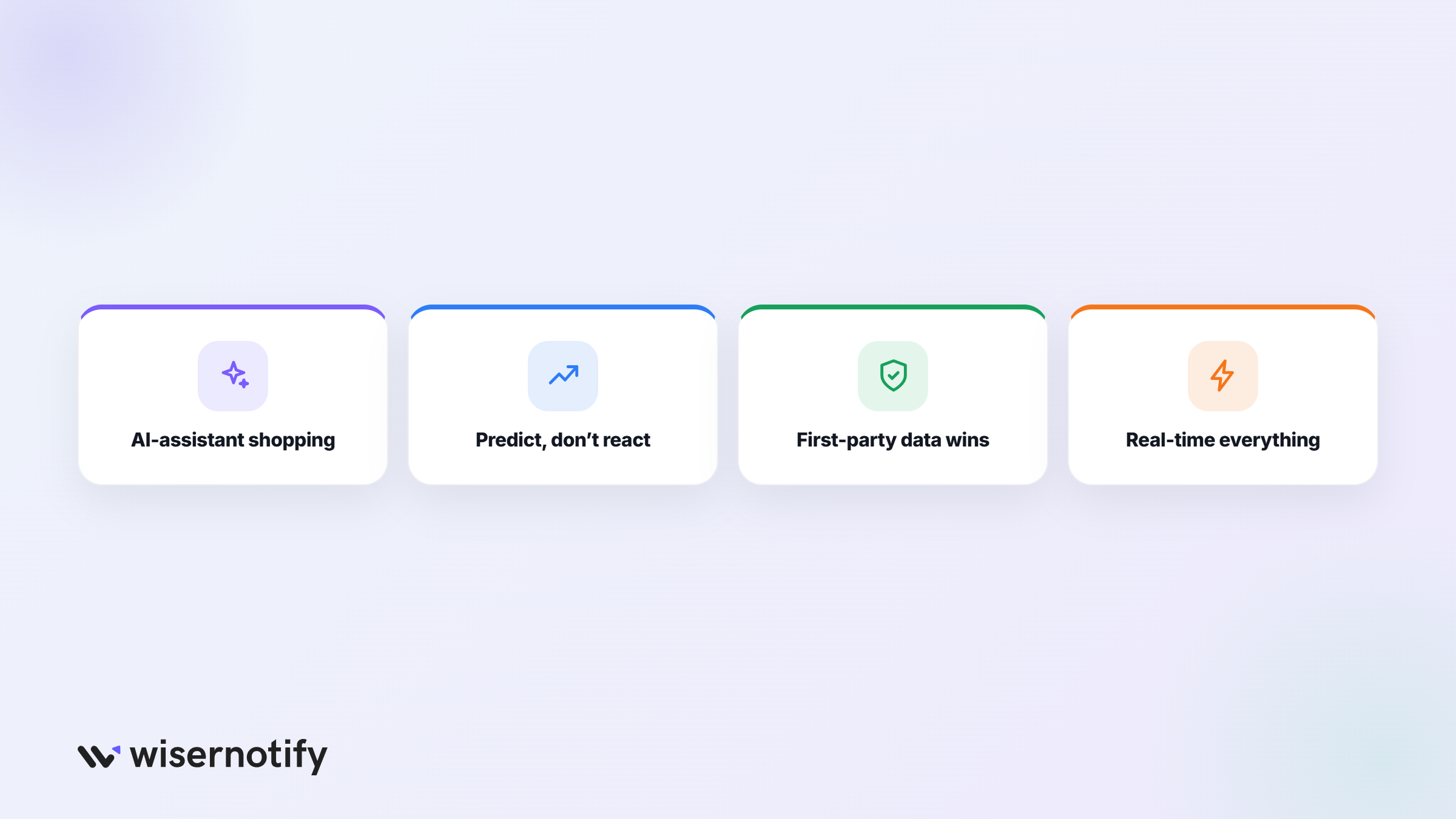
Four shifts are shaping the next few years, and all four are already visible in the numbers above.
Shopping through AI assistants. People now ask ChatGPT and Gemini what to buy, and those visitors convert better than almost any other channel. Getting your products and proof into AI answers is becoming its own discipline, the same way SEO once did.
From reacting to predicting. The old model waited for a shopper to act, then responded. The new model predicts what each person wants next and prepares the page, the email, and the offer before they ask.
First-party data wins. With privacy rules tightening and third-party tracking fading, the stores that collect data directly from their own customers hold the advantage. It performs better anyway.
Real-time everything. Shoppers respond most to what is happening right now: live recommendations, current offers, and real social proof like recent purchases and fresh reviews. Static pages read as stale. More on that in our guide to personalized marketing in ecommerce.

Boost Conversion Instantly
Add Social Proof & Urgency to your website
Wrap Up
Shoppers are clear about what they want. They like stores that know them, they buy more from those stores, and they leave the ones that treat everyone the same.
The tools are ready too. AI can now match every shopper with the right products, and more people are shopping through AI assistants every month.
So start small. Personalize your product suggestions, your emails, and your offers. Add real proof like reviews and recent sales. When shoppers see things made for them, they buy.
Sources
McKinsey | Twilio | Twilio Segment | Salesforce | Adobe | Barilliance | Epsilon | Accenture
Frequently Asked Questions
How many shoppers expect personalization?
Most shoppers do. About 7 in 10 expect it, and they get frustrated when they don’t get it.
How much can personalization increase revenue?
Most stores see a 10% to 15% revenue lift, and it also lowers the cost of winning new customers.
How much revenue comes from product recommendations?
A lot. Up to a third of a store’s revenue can come from personalized recommendations alone.
How many companies use AI personalization?
Almost all of them. AI now handles most of the matching between shoppers and products, and AI assistants are becoming a shopping channel of their own.
Do shoppers trust personalization?
They like it, but they want honesty and control. Tell shoppers what data you collect and let them adjust it.

Krunal Vaghasiya is a marketing tech expert who boosts e-commerce conversion rates with automated social proof and FOMO strategies. He loves to keep posting insightful posts on online marketing software, marketing automations, and improving conversion rates.




 Capterra